7 Best USB Audio Interfaces for Home Recording in 2026
The Focusrite Scarlett 2i2 4th Gen is the safest first interface for most home recorders: two mic preamps, USB-C, and a mature software bundle. If you need more inputs for drums or a band, the MOTU M4 adds two line inputs and loopback. If you record alone and want the lowest cost of entry, the Behringer UMC202HD covers the basics.
 By Shihab Mia · Published 21 Nov 2026
We run no ads and no affiliate links at launch. The order of a list follows our published method. How lists are ordered: how we score.
Prices are the starting prices vendors list publicly. Plans change, so confirm the current price on the vendor page before you buy.
Key takeaways
- Two mic inputs is the practical minimum for most solo and duo recording; four or more inputs costs noticeably more.
- Prices below are manufacturer list prices in USD; street prices vary by retailer and region.
- All seven models here are USB bus-powered or use a standard external supply, so no PCIe slot is needed.
- Every interface listed ships with some recording software or plugin bundle; check what is included before buying.
- Sample rate and bit depth are rarely the limiting factor today; preamp quality and driver stability matter more.
Side-by-side
Grouped by fit and cost. Tap a product to jump to its full entry.
| Fit | Cost | |||
|---|---|---|---|---|
| Product | Best for | Standout feature | Listed starting price | Free plan or trial |
| 1Focusrite Scarlett 2i2 4th Gen | First interface for solo vocal and guitar recording | Two combo inputs with switchable air mode | Check current retail price (two-input USB-C model) | One-time hardware purchase |
| 2MOTU M4 | Small bands and podcasters who need loopback | Four inputs including two combo jacks | Check current retail price (four-input USB-C model) | One-time hardware purchase |
| 3Behringer UMC202HD | The cheapest credible two-input starter box | Very low cost for two mic preamps | Check current retail price (two-input USB model) | One-time hardware purchase |
| 4Universal Audio Volt 276 | Vocals that need compression on the way in | Built-in analog compressor | Check current retail price (two-input model with compressor) | One-time hardware purchase |
| 5Audient iD14 MKII | Clean, neutral preamps for critical tracking | Class-A Audient console preamps | Check current retail price (two-input USB-C model) | One-time hardware purchase |
| 6PreSonus Studio 24c | Studio One users who want one ecosystem | Bundled Studio One software | Check current retail price (two-input USB-C model) | One-time hardware purchase |
| 7Steinberg UR22C | Cubase users and recording to an iPad | Bundled Cubase software | Check current retail price (two-input USB-C model) | One-time hardware purchase |
How we picked
This guide is based on research, not lab testing. We read each manufacturer's product page, spec sheet and user manual, then compared input counts, connection type, bundled software and published prices. We prioritized models released between 2023 and 2025 that the vendor still lists as current. Where a specification was unclear or not published, we described it qualitatively instead of quoting a number. Prices are manufacturer list prices in USD and change often, so confirm before buying.
The 7 picks in detail

- Best for
- First interface for solo vocal and guitar recording
- Standout
- Two combo inputs with switchable air mode
- Starting price
- Check current retail price (two-input USB-C model)
- Free plan or trial
- One-time hardware purchase
The Scarlett 2i2 is the model most people start with, and the 4th Gen keeps the same two combo XLR/TRS inputs with switchable instrument mode. Focusrite lists 24-bit/192 kHz conversion and a pair of headphone outputs is not included here, so check the spec sheet for the exact output layout before you buy. The gain knobs have halo indicators, which helps in a dark room.
It suits a single person tracking vocals and guitar one part at a time. The catch is expansion: with only two inputs you cannot mic a full kit, and there are no MIDI DIN ports, so a MIDI keyboard needs its own USB connection. The bundled software is the main reason it competes at this price.
Where the price comes from
Check current retail price (two-input USB-C model). Hardware prices move often, so check the Focusrite Scarlett 2i2 4th Gen maker page or a retailer before you buy.
Benefits
- Two combo inputs with switchable air mode
- USB-C bus power with no supply needed
- Large software bundle included
Drawbacks
- Only two inputs, so no room for a drum kit
- No MIDI ports on this model
Use case to skip: this limit matters to you: only two inputs, so no room for a drum kit.
Our take. A sensible pick for first interface for solo vocal and guitar recording.
If it does not fit, compare MOTU M4 or Behringer UMC202HD in this list.
- Best for
- Small bands and podcasters who need loopback
- Standout
- Four inputs including two combo jacks
- Starting price
- Check current retail price (four-input USB-C model)
- Free plan or trial
- One-time hardware purchase
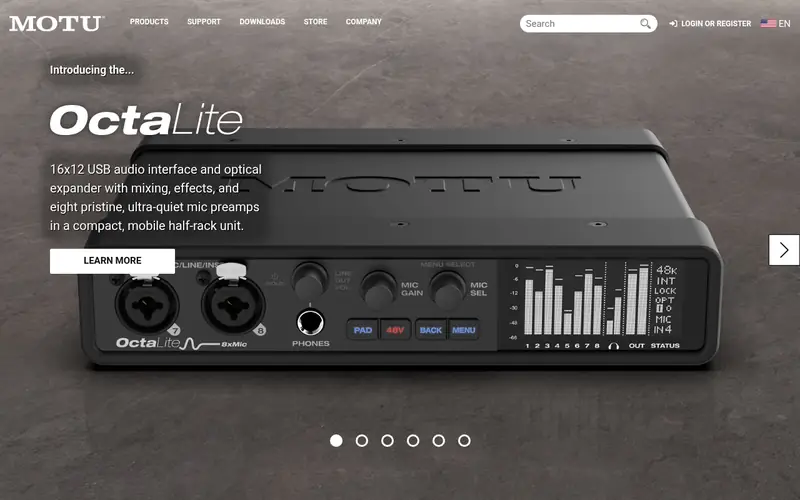
The M4 gives you two mic preamps plus two line inputs on the back, which is enough for a singer-guitarist plus a keyboard or a second mic. MOTU lists ESS Sabre32 converters and a loopback channel that mixes computer audio back into the recording, useful for streaming and screen capture.
It suits a small band tracking together or anyone who records while streaming. The main catch is size and price: it takes more desk space than a 2i2 and costs more, so it only makes sense if you will actually use the extra inputs.
Where the price comes from
Check current retail price (four-input USB-C model). Hardware prices move often, so check the MOTU M4 maker page or a retailer before you buy.
Benefits
- Four inputs including two combo jacks
- Built-in loopback for streaming
- Clear front-panel metering
Drawbacks
- Costs more than two-input rivals
- Larger footprint on a small desk
Use case to skip: this limit matters to you: costs more than two-input rivals.
Our take. A sensible pick for small bands and podcasters who need loopback.
If it does not fit, compare Focusrite Scarlett 2i2 4th Gen or Behringer UMC202HD in this list.
- Best for
- The cheapest credible two-input starter box
- Standout
- Very low cost for two mic preamps
- Starting price
- Check current retail price (two-input USB model)
- Free plan or trial
- One-time hardware purchase
The UMC202HD is the budget option that still gives you two combo inputs with MIDAS-designed preamps, plus MIDI DIN ports that many pricier interfaces omit. Behringer lists 24-bit/192 kHz operation and phantom power on both channels.
It suits a beginner who wants to spend as little as possible and already owns a DAW. The catch is the software and driver experience: the bundle is thinner than Focusrite's, and the connection is USB-B rather than USB-C, so you need the right cable.
Where the price comes from
Check current retail price (two-input USB model). Hardware prices move often, so check the Behringer UMC202HD maker page or a retailer before you buy.
Benefits
- Very low cost for two mic preamps
- MIDI in and out included
- Metal chassis
Drawbacks
- Driver and software bundle less polished
- No USB-C
Use case to skip: this limit matters to you: driver and software bundle less polished.
Our take. A sensible pick for the cheapest credible two-input starter box.
If it does not fit, compare Focusrite Scarlett 2i2 4th Gen or MOTU M4 in this list.

- Best for
- Vocals that need compression on the way in
- Standout
- Built-in analog compressor
- Starting price
- Check current retail price (two-input model with compressor)
- Free plan or trial
- One-time hardware purchase
The Volt 276 pairs two combo inputs with a built-in analog compressor based on the UA 1176, plus a switchable vintage preamp voicing. Universal Audio lists 24-bit/192 kHz conversion and a bundled plugin package.
It suits a vocalist who wants a finished-sounding take without plugin latency. The catch is flexibility: the compressor has a preset character rather than full controls, and with two inputs it is still a solo or duo box.
Where the price comes from
Check current retail price (two-input model with compressor). Hardware prices move often, so check the Universal Audio Volt 276 maker page or a retailer before you buy.
Benefits
- Built-in analog compressor
- Vintage mic preamp mode
- Solid metal build
Drawbacks
- Compression is fixed, not adjustable in detail
- Two inputs only
Use case to skip: this limit matters to you: compression is fixed, not adjustable in detail.
Our take. A sensible pick for vocals that need compression on the way in.
If it does not fit, compare Focusrite Scarlett 2i2 4th Gen or MOTU M4 in this list.

- Best for
- Clean, neutral preamps for critical tracking
- Standout
- Class-A Audient console preamps
- Starting price
- Check current retail price (two-input USB-C model)
- Free plan or trial
- One-time hardware purchase
The iD14 MKII uses the same Class-A preamp design as Audient's larger consoles, with two combo inputs and an ADAT optical input that lets you add eight more channels with an external preamp. Audient lists 24-bit/96 kHz operation on this model, so check the spec sheet if you need higher rates.
It suits someone who records acoustic sources and wants a neutral, low-coloration preamp, or who plans to expand later via ADAT. The catch is price and input count: you pay more for two inputs than you would with a four-input rival.
Where the price comes from
Check current retail price (two-input USB-C model). Hardware prices move often, so check the Audient iD14 MKII maker page or a retailer before you buy.
Benefits
- Class-A Audient console preamps
- ADAT input for adding channels later
- Scroll control for DAW monitoring
Drawbacks
- Higher price than entry models
- Two analog inputs only
Use case to skip: this limit matters to you: higher price than entry models.
Our take. A sensible pick for clean, neutral preamps for critical tracking.
If it does not fit, compare Focusrite Scarlett 2i2 4th Gen or MOTU M4 in this list.
- Best for
- Studio One users who want one ecosystem
- Standout
- Bundled Studio One software
- Starting price
- Check current retail price (two-input USB-C model)
- Free plan or trial
- One-time hardware purchase
The Studio 24c is a two-input USB-C interface with combo jacks, phantom power, and a bundle that includes PreSonus Studio One. PreSonus lists 24-bit/192 kHz conversion and direct monitoring via a mix knob.
It suits a new recorder who wants an interface and a DAW in one purchase and does not already own software. The catch is the same as other two-input boxes: no room to grow, and no MIDI ports for hardware synths.
Where the price comes from
Check current retail price (two-input USB-C model). Hardware prices move often, so check the PreSonus Studio 24c maker page or a retailer before you buy.
Benefits
- Bundled Studio One software
- Two combo inputs with phantom power
- Compact USB-C body
Drawbacks
- Two inputs only
- No MIDI DIN ports
Use case to skip: this limit matters to you: two inputs only.
Our take. A sensible pick for studio One users who want one ecosystem.
If it does not fit, compare Focusrite Scarlett 2i2 4th Gen or MOTU M4 in this list.

- Best for
- Cubase users and recording to an iPad
- Standout
- Bundled Cubase software
- Starting price
- Check current retail price (two-input USB-C model)
- Free plan or trial
- One-time hardware purchase
The UR22C offers two combo inputs, MIDI DIN in and out, and USB-C connectivity, with a bundle that includes Cubase. Steinberg lists 24-bit/192 kHz operation and onboard DSP for monitoring effects.
It suits someone already working in Cubase, or anyone who wants to record into an iPad as well as a computer. The catch is input count and the DSP: the onboard effects are useful for monitoring but limited compared with plugin processing.
Where the price comes from
Check current retail price (two-input USB-C model). Hardware prices move often, so check the Steinberg UR22C maker page or a retailer before you buy.
Benefits
- Bundled Cubase software
- Works with iOS devices
- MIDI in and out included
Drawbacks
- Two analog inputs only
- DSP effects are basic
Use case to skip: this limit matters to you: two analog inputs only.
Our take. A sensible pick for cubase users and recording to an iPad.
If it does not fit, compare Focusrite Scarlett 2i2 4th Gen or MOTU M4 in this list.
What specs matter when you buy
Input count is the first decision. Two combo inputs cover one vocal mic plus one guitar, or two mics on a single source. If you plan to record a drum kit or a band playing together, you need four or more inputs, and that usually means a higher price and a larger box. Count the sources you will record at once, then add one spare.
Preamp quality and gain range matter more than sample rate for most home setups. Look for a published gain figure in dB and an equivalent input noise figure if the vendor lists one; if not, read the manual rather than guessing. Phantom power on every mic input is standard now, but confirm it is switchable per channel if you use a ribbon mic.
Connection type and power are practical concerns. USB-C is now common, but USB-B and USB-A models still work fine. Bus-powered interfaces avoid a wall wart but can struggle with high-impedance headphones. Check whether the model has MIDI DIN ports if you own hardware synths, and check the driver support page for your operating system before buying.
Questions worth answering first
Buying checklist
- Count how many sources you will record at once and buy at least one input more than that.
- Confirm the interface's driver is supported on your exact operating system version.
- Check whether the model is bus-powered or needs an external power supply.
- Verify the bundled software includes a DAW you are willing to learn.
- Confirm MIDI DIN ports are present if you own hardware synths.
- Read the return policy and confirm the retailer's price before paying.
FAQ
Do I need more than two inputs?
Only if you record multiple sources at once. Two inputs handle one vocal mic and one guitar, or a stereo pair. A drum kit or a band playing live needs four or more. Buying extra inputs you never use costs money and desk space.
Is USB-C better than USB-B for audio?
Not for audio quality. Both carry the same digital data. USB-C is more convenient because the cable is reversible and common on modern laptops. Choose based on driver support and features, not the connector shape.
Do I need an external power supply?
Not always. Many two-input interfaces are bus-powered over USB. Bus power is convenient but can limit headphone output on some laptops. Check the spec sheet for the headphone output power if you mix on headphones.
What sample rate should I record at?
44.1 or 48 kHz is enough for most music and video work. Higher rates increase file size and CPU load with little audible benefit for typical home recordings. Use the rate your DAW project and collaborators expect.
Can I use an audio interface with an iPad?
Some models support iOS, but not all. Check the manufacturer's compatibility page before buying. You may also need a camera connection kit or a powered hub, depending on the iPad's port and the interface's power draw.
Is a bundled DAW worth it?
It can be, especially for a first setup. Bundles range from a full DAW to a light version with track limits. Check the track count and plugin limits of the included version before you rely on it.
Sources we checked
Change log: First published 21 Nov 2026.