7 Best Mid-Tower ATX PC Cases in 2026
The Fractal Design North is our top pick for most builders: a compact mid-tower with real wood detailing, strong airflow and sensible clearances for modern graphics cards. Choose the Lian Li Lancool 216 if you want maximum airflow and radiator room for the money. Pick the Fractal Design Meshify 2 if you need a large, flexible interior for big radiators and long GPUs.
 By Shihab Mia · Published 21 Nov 2026
We run no ads and no affiliate links at launch. The order of a list follows our published method. How lists are ordered: how we score.
Prices are the starting prices vendors list publicly. Plans change, so confirm the current price on the vendor page before you buy.
Key takeaways
- Mid-tower ATX cases generally run from about $80 to $180; the picks here sit mostly between $100 and $160.
- GPU clearance is the number to check first: many modern cards are 330 mm or longer.
- Mesh front panels and top exhaust mounts matter more than fan count for airflow.
- Front USB-C is common now but not universal; confirm it on the spec sheet.
- Check radiator support per position, not just the total number of fans.
Side-by-side
Grouped by fit and cost. Tap a product to jump to its full entry.
| Fit | Cost | |||
|---|---|---|---|---|
| Product | Best for | Standout feature | Listed starting price | Free plan or trial |
| 1Fractal Design North | Wood-accent airflow builds | Real wood front slats give a distinct look | Check current retail price (mid-tower ATX) | One-time hardware purchase |
| 2Lian Li Lancool 216 | High airflow on a budget | Two large front fans included | Check current retail price (mid-tower ATX) | One-time hardware purchase |
| 3Fractal Design Meshify 2 | Big radiators and long GPUs | Large interior with flexible storage | Check current retail price (mid-tower ATX) | One-time hardware purchase |
| 4Corsair 4000D Airflow | Clean, simple first build | Mesh front for airflow | Check current retail price (mid-tower ATX) | One-time hardware purchase |
| 5NZXT H7 Flow | Quiet airflow with cable covers | Perforated front and top for airflow | Check current retail price (mid-tower ATX) | One-time hardware purchase |
| 6be quiet! Pure Base 500DX | Low-noise builds | Sound-dampening panels | Check current retail price (mid-tower ATX) | One-time hardware purchase |
| 7Cooler Master MasterBox TD500 Mesh V2 | Showcase builds with mesh airflow | Geometric mesh front | Check current retail price (mid-tower ATX) | One-time hardware purchase |
How we picked
We compared these cases using manufacturer product pages, published spec sheets, and current retail listings. We looked at board support, GPU and cooler clearances, radiator mounts, front I/O, included fans, and published dimensions. We did not run hands-on thermal or noise tests. Prices are shown as "check current retail price" because case pricing varies by region and retailer, and we did not want to quote a figure that may be out of date.
The 7 picks in detail

- Best for
- Wood-accent airflow builds
- Standout
- Real wood front slats give a distinct look
- Starting price
- Check current retail price (mid-tower ATX)
- Free plan or trial
- One-time hardware purchase
The North is a mid-tower ATX case with a walnut or oak front panel set into a mesh intake. Fractal Design lists support for ATX, micro-ATX and mini-ITX boards, a tempered glass side panel, and front USB-C among the I/O options. The mesh front and vented top are designed for airflow rather than silence.
It suits builders who want a case that looks different without giving up cooling. The main catch is space: check the published GPU length limit before buying a triple-fan card, especially if you also plan a front-mounted radiator. Fractal Design publishes clearance figures per configuration on the product page.
Where the price comes from
Check current retail price (mid-tower ATX). Hardware prices move often, so check the Fractal Design North maker page or a retailer before you buy.
Benefits
- Real wood front slats give a distinct look
- mesh front and top support good airflow
- compact footprint for an ATX case
Drawbacks
- Wood finish limits colour options
- tight clearance for very long GPUs with front radiators
Use case to skip: this limit matters to you: wood finish limits colour options.
Our take. A sensible pick for wood-accent airflow builds.
If it does not fit, compare Lian Li Lancool 216 or Fractal Design Meshify 2 in this list.

- Best for
- High airflow on a budget
- Standout
- Two large front fans included
- Starting price
- Check current retail price (mid-tower ATX)
- Free plan or trial
- One-time hardware purchase
The Lancool 216 is a mesh-front mid-tower that ships with two 160 mm front fans and a rear exhaust fan, according to Lian Li. The case supports ATX boards, has a tempered glass side panel, and offers front USB-C on its I/O panel. Lian Li lists support for large radiators in the front and top.
It is aimed at builders who want airflow out of the box without adding fans. The trade-off is noise: big fans move a lot of air, and at high RPM they are audible. Check the vendor's fan curve guidance and your motherboard's fan headers before assuming a quiet result.
Where the price comes from
Check current retail price (mid-tower ATX). Hardware prices move often, so check the Lian Li Lancool 216 maker page or a retailer before you buy.
Benefits
- Two large front fans included
- mesh front and top
- strong radiator support for the price
Drawbacks
- Large fans can be louder at full speed
- cable management space is average
Use case to skip: this limit matters to you: large fans can be louder at full speed.
Our take. A sensible pick for high airflow on a budget.
If it does not fit, compare Fractal Design North or Fractal Design Meshify 2 in this list.
- Best for
- Big radiators and long GPUs
- Standout
- Large interior with flexible storage
- Starting price
- Check current retail price (mid-tower ATX)
- Free plan or trial
- One-time hardware purchase
The Meshify 2 is Fractal Design's larger mid-tower, with an angular mesh front and a modular interior. The vendor lists support for ATX and smaller boards, multiple radiator positions, and a range of storage mounts. It is designed for custom loops and long graphics cards.
It suits builders who need room more than they need a small footprint. The catch is size: it takes up more desk or floor space and weighs more than compact mid-towers. Confirm the exact GPU and radiator limits on the current spec sheet, since Fractal Design sells several Meshify 2 variants.
Where the price comes from
Check current retail price (mid-tower ATX). Hardware prices move often, so check the Fractal Design Meshify 2 maker page or a retailer before you buy.
Benefits
- Large interior with flexible storage
- mesh front for airflow
- strong radiator support
Drawbacks
- Bigger footprint than most mid-towers
- heavier than compact alternatives
Use case to skip: this limit matters to you: bigger footprint than most mid-towers.
Our take. A sensible pick for big radiators and long GPUs.
If it does not fit, compare Fractal Design North or Lian Li Lancool 216 in this list.
- Best for
- Clean, simple first build
- Standout
- Mesh front for airflow
- Starting price
- Check current retail price (mid-tower ATX)
- Free plan or trial
- One-time hardware purchase
The 4000D Airflow is a mid-tower ATX case with a mesh front panel and a tempered glass side. Corsair lists support for ATX and smaller boards, front USB-C on the I/O panel, and a range of fan and radiator mounts. It is one of the most common starting points for first builds.
It suits builders who want a simple, tidy case without paying for extras. The catch is that it ships with fewer fans than some competitors, so budget for one or two more. Check the vendor page for the exact radiator and GPU limits before buying a large card.
Where the price comes from
Check current retail price (mid-tower ATX). Hardware prices move often, so check the Corsair 4000D Airflow maker page or a retailer before you buy.
Benefits
- Mesh front for airflow
- straightforward interior
- widely available
Drawbacks
- Fewer included fans than some rivals
- limited space for very large radiators
Use case to skip: this limit matters to you: fewer included fans than some rivals.
Our take. A sensible pick for clean, simple first build.
If it does not fit, compare Fractal Design North or Lian Li Lancool 216 in this list.
- Best for
- Quiet airflow with cable covers
- Standout
- Perforated front and top for airflow
- Starting price
- Check current retail price (mid-tower ATX)
- Free plan or trial
- One-time hardware purchase
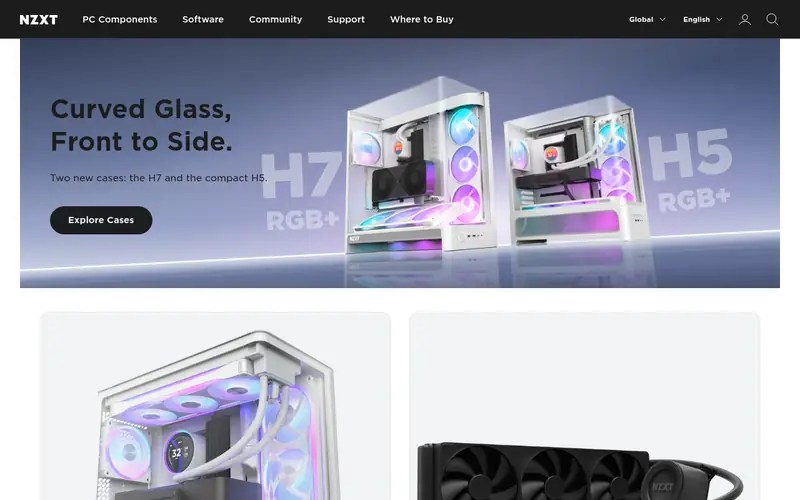
The H7 Flow is NZXT's airflow-focused mid-tower, with a perforated front panel and top venting. NZXT lists support for ATX boards, a tempered glass side panel, front USB-C, and integrated cable management covers. It is sold in several colour and fan configurations.
It suits builders who want a tidy interior and good airflow without a mesh-only look. The catch is price and version drift: NZXT has revised the H7 line, so confirm which version a retailer is selling and what fans it includes. Check the vendor page for current GPU and radiator limits.
Where the price comes from
Check current retail price (mid-tower ATX). Hardware prices move often, so check the NZXT H7 Flow maker page or a retailer before you buy.
Benefits
- Perforated front and top for airflow
- built-in cable covers
- clean interior
Drawbacks
- Pricier than basic mesh cases
- included fan count varies by version
Use case to skip: this limit matters to you: pricier than basic mesh cases.
Our take. A sensible pick for quiet airflow with cable covers.
If it does not fit, compare Fractal Design North or Lian Li Lancool 216 in this list.
- Best for
- Low-noise builds
- Standout
- Sound-dampening panels
- Starting price
- Check current retail price (mid-tower ATX)
- Free plan or trial
- One-time hardware purchase
The Pure Base 500DX is a mid-tower ATX case from be quiet! that combines a mesh front with sound-dampening material on the panels. The vendor lists support for ATX boards, a tempered glass side, front USB-C, and included fans. It is designed as a quieter alternative to open mesh cases.
It suits builders who want lower noise without giving up all airflow. The catch is that sound dampening adds weight and can trap heat if fan speeds are set too low. Check the vendor's fan and radiator support figures, and plan a fan curve that keeps temperatures in check.
Where the price comes from
Check current retail price (mid-tower ATX). Hardware prices move often, so check the be quiet! Pure Base 500DX maker page or a retailer before you buy.
Benefits
- Sound-dampening panels
- mesh front for airflow
- included fans
Drawbacks
- Heavier than airflow-first cases
- thermals depend on fan setup
Use case to skip: this limit matters to you: heavier than airflow-first cases.
Our take. A sensible pick for low-noise builds.
If it does not fit, compare Fractal Design North or Lian Li Lancool 216 in this list.
- Best for
- Showcase builds with mesh airflow
- Standout
- Geometric mesh front
- Starting price
- Check current retail price (mid-tower ATX)
- Free plan or trial
- One-time hardware purchase
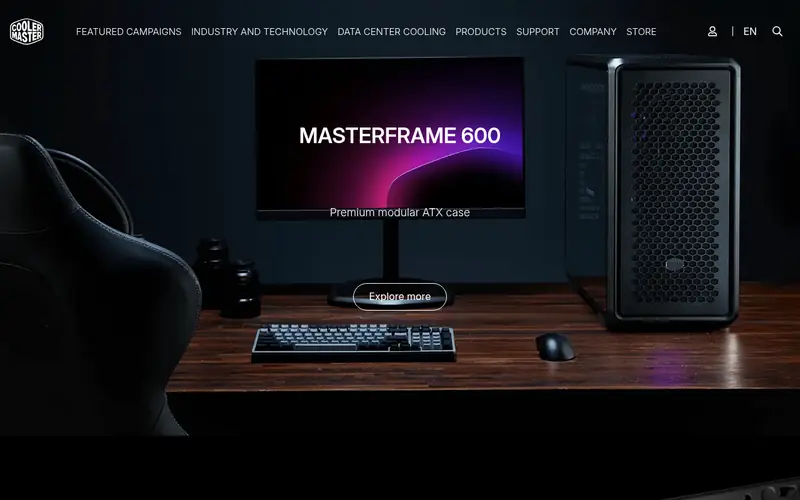
The MasterBox TD500 Mesh V2 is a mid-tower ATX case with a faceted mesh front and a tempered glass side panel. Cooler Master lists support for ATX boards, front USB-C, and included ARGB fans. The design is aimed at builders who want a visible, lit interior.
It suits builders who want a showcase case with airflow rather than a plain box. The catch is the styling, which is polarising, and average cable management depth. Confirm the GPU length limit and radiator support on the vendor page before buying a large card or a thick top radiator.
Where the price comes from
Check current retail price (mid-tower ATX). Hardware prices move often, so check the Cooler Master MasterBox TD500 Mesh V2 maker page or a retailer before you buy.
Benefits
- Geometric mesh front
- tempered glass side
- included ARGB fans
Drawbacks
- Styling is divisive
- cable space is average
Use case to skip: this limit matters to you: styling is divisive.
Our take. A sensible pick for showcase builds with mesh airflow.
If it does not fit, compare Fractal Design North or Lian Li Lancool 216 in this list.
What specs matter when you buy
Start with GPU clearance. Modern triple-fan cards are often 330 mm or longer, and front-mounted radiators eat into that space. The vendor spec sheet lists a maximum GPU length, sometimes with and without a front fan or radiator installed. Measure your card and add a margin.
Next, check radiator support per position. A case may list "360 mm radiator support" but only in the front, not the top. If you plan a top-mounted AIO, confirm the top mount dimensions and the clearance to the motherboard and RAM. Also check CPU cooler height, which matters for large air coolers.
Then look at airflow and I/O. Mesh front panels generally move more air than solid panels, and top exhaust mounts help heat escape. Confirm front USB-C if you need it, and count the USB-A ports. Finally, check drive mounts, dust filters, and the published dimensions against your desk or shelf space.
Questions worth answering first
Buying checklist
- Confirm the maximum GPU length on the vendor spec sheet and compare it with your card's length.
- Check radiator support for the exact position you plan to use, front or top.
- Verify CPU cooler height clearance if you use a large air cooler.
- Confirm the case has front USB-C if your motherboard supports it and you need the port.
- Measure your desk or shelf space against the published case dimensions.
- Check how many fans are included and whether your motherboard has enough fan headers.
FAQ
What is the best mid-tower ATX case overall?
The Fractal Design North is our top pick for most builders because it combines a mesh front, a compact footprint, and a distinctive wood finish. If you need more radiator room, the Fractal Design Meshify 2 is the better choice. Confirm current clearances on the vendor page before buying.
How much should I spend on a mid-tower case?
Most solid mid-tower ATX cases sit between roughly $80 and $180. Spending more usually buys better airflow, more included fans, or nicer materials. Check current retail prices, since case pricing moves with sales and regional stock.
Do I need a mesh front panel?
A mesh front generally allows more airflow than a solid panel, which helps with GPU and CPU temperatures. Solid panels with sound dampening can be quieter but may run warmer. Choose based on whether you prioritise noise or cooling.
Will a 360 mm radiator fit in a mid-tower?
Many mid-towers support a 360 mm radiator, but often only in the front or only in the top. Check the vendor spec sheet for the exact position and the clearance to the motherboard. Some cases list 360 mm support with caveats about fan thickness.
Is front USB-C worth checking?
Yes, if your motherboard has a USB-C front-panel header and you use USB-C devices. Not every mid-tower includes it, and some only offer it on certain versions. Confirm it on the spec sheet before buying.
How many fans should a case include?
Two or three included fans is common for mid-towers. That is usually enough for a basic build, but high-power GPUs may benefit from more. Check your motherboard's fan headers and consider a fan hub if you add more.
Sources we checked
Change log: First published 21 Nov 2026.