7 Best 3D Printer Filaments to Buy in 2026
Prusament PLA is the top pick for most people: Prusa publishes tight diameter tolerances and full material data, and it prints reliably on any printer with a standard hotend. Choose Polymaker PolyTerra PLA if you want lower-cost PLA with a matte finish, or Bambu Lab PETG HF if you need tougher parts and own a Bambu Lab machine with an AMS.
 By Shihab Mia · Published 21 Nov 2026
We run no ads and no affiliate links at launch. The order of a list follows our published method. How lists are ordered: how we score.
Prices are the starting prices vendors list publicly. Plans change, so confirm the current price on the vendor page before you buy.
Key takeaways
- Prusament PLA ships in 1 kg spools with a stated diameter tolerance of +/- 0.02 mm.
- Polymaker PolyTerra PLA is a lower-cost matte PLA aimed at general printing and visual models.
- Bambu Lab filaments carry RFID tags that let its printers auto-detect material settings.
- PETG and ASA cost more than PLA but handle heat and outdoor use better.
- Always check the spool diameter and material before buying; not every brand fits every feeder.
Side-by-side
Grouped by fit and cost. Tap a product to jump to its full entry.
| Fit | Cost | |||
|---|---|---|---|---|
| Product | Best for | Standout feature | Listed starting price | Free plan or trial |
| 1Prusament PLA | Reliable everyday PLA with published tolerances | Tight stated diameter tolerance | $29.99 per 1 kg spool (vendor site) | One-time hardware purchase |
| 2Polymaker PolyTerra PLA | Low-cost matte PLA for visual models | Matte surface hides layer lines | See vendor site (1 kg spools) | One-time hardware purchase |
| 3Bambu Lab PETG HF | Bambu Lab owners who want tough parts with auto settings | RFID tag lets Bambu printers load settings automatically | See vendor site (1 kg spools) | One-time hardware purchase |
| 4Sunlu PLA+ | Budget bulk printing | Low cost per spool | See vendor site (1 kg spools) | One-time hardware purchase |
| 5Overture PLA Professional | Dimensional accuracy on a budget | Vendor states tight diameter tolerance | See vendor site (1 kg spools) | One-time hardware purchase |
| 6Polymaker PolyLite ASA | Outdoor and heat-resistant parts | UV and weather resistance better than PLA or PETG | See vendor site (1 kg spools) | One-time hardware purchase |
| 7Prusament PETG | Strong functional parts with published specs | Same published tolerance and datasheet approach as Prusament PLA | See vendor site (1 kg spools) | One-time hardware purchase |
How we picked
This guide is based on research, not lab testing. We read vendor product pages, published datasheets, diameter tolerance statements and material descriptions for each filament line, then compared them on documentation quality, material properties, spool format and published price. We favored lines that are currently sold and that publish enough technical detail for a buyer to set up a profile. Prices are the manufacturer's own figures where listed; otherwise we point to the vendor site because retail pricing varies by region and channel.
The 7 picks in detail
- Best for
- Reliable everyday PLA with published tolerances
- Standout
- Tight stated diameter tolerance
- Starting price
- $29.99 per 1 kg spool (vendor site)
- Free plan or trial
- One-time hardware purchase
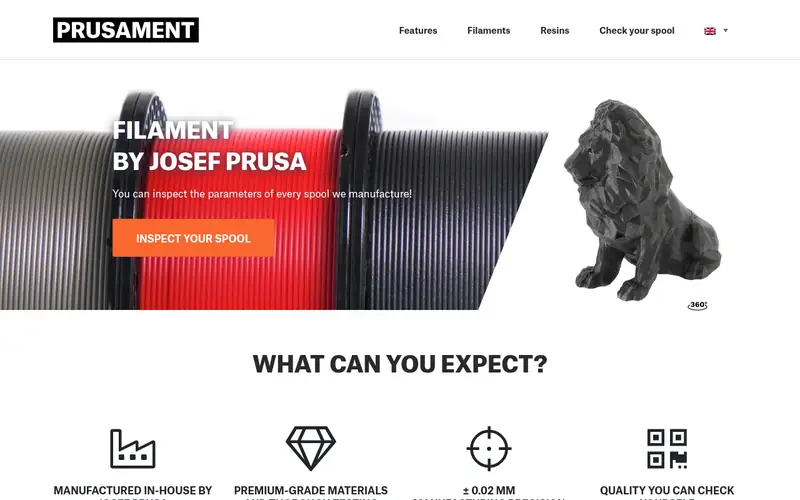
Prusament PLA is Prusa's own filament line, made in the Czech Republic. Prusa publishes a diameter tolerance of +/- 0.02 mm and a material datasheet for each color, which makes it easy to set temperatures and compare batches. It prints on essentially any FDM printer with a standard hotend, not just Prusa machines.
The catch is price and shipping. At $29.99 per 1 kg it costs more than budget brands, and buyers outside Europe should factor in delivery. For anyone who wants predictable results without tuning, the published specs are the main selling point.
Where the price comes from
$29.99 per 1 kg spool (vendor site). Hardware prices move often, so check the Prusament PLA maker page or a retailer before you buy.
Benefits
- Tight stated diameter tolerance
- full technical datasheet per color
- consistent winding on the spool
Drawbacks
- Higher price than budget PLA
- shipping from Prusa adds cost in some regions
Use case to skip: this limit matters to you: higher price than budget PLA.
Our take. A sensible pick for reliable everyday PLA with published tolerances.
If it does not fit, compare Polymaker PolyTerra PLA or Bambu Lab PETG HF in this list.
- Best for
- Low-cost matte PLA for visual models
- Standout
- Matte surface hides layer lines
- Starting price
- See vendor site (1 kg spools)
- Free plan or trial
- One-time hardware purchase
PolyTerra is Polymaker's matte PLA line, aimed at models and decorative prints where surface finish matters more than strength. The matte look reduces visible layer lines, and Polymaker states the material is designed to be easier to sand and post-process than glossy PLA.
It is a PLA blend, so it prints at typical PLA temperatures and works on standard hardware. The trade-off is mechanical: matte blends generally sacrifice some impact strength. Check the vendor site for current pricing and color stock.
Where the price comes from
See vendor site (1 kg spools). Hardware prices move often, so check the Polymaker PolyTerra PLA maker page or a retailer before you buy.
Benefits
- Matte surface hides layer lines
- marketed as easier to sand
- wide color range
Drawbacks
- Less strong than standard PLA blends
- availability varies by region
Use case to skip: this limit matters to you: less strong than standard PLA blends.
Our take. A sensible pick for low-cost matte PLA for visual models.
If it does not fit, compare Prusament PLA or Bambu Lab PETG HF in this list.
- Best for
- Bambu Lab owners who want tough parts with auto settings
- Standout
- RFID tag lets Bambu printers load settings automatically
- Starting price
- See vendor site (1 kg spools)
- Free plan or trial
- One-time hardware purchase
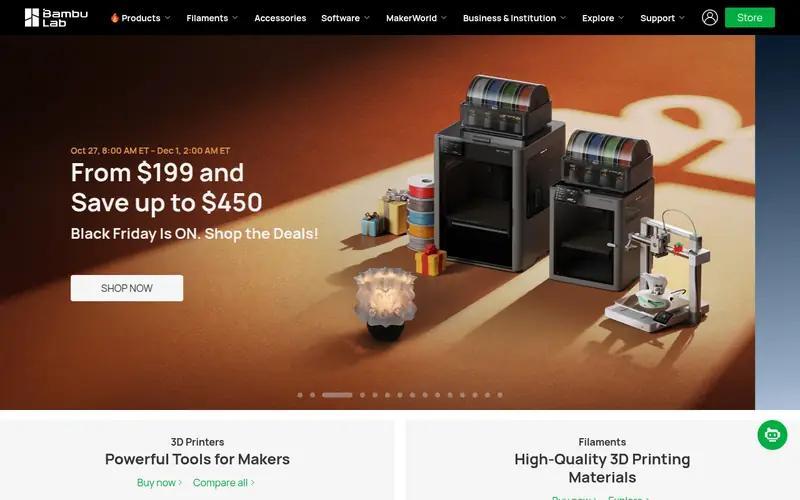
PETG HF is Bambu Lab's high-flow PETG, sold on 1 kg spools with an RFID tag. On Bambu Lab printers with an AMS, the machine reads the tag and applies the matching profile, which removes most of the guesswork around temperatures and flow.
PETG itself is tougher and more heat-resistant than PLA, so it suits brackets, enclosures and parts that see load. The catch is that the auto-detection benefit only applies to Bambu hardware. On other printers it is ordinary PETG that needs a profile you tune yourself.
Where the price comes from
See vendor site (1 kg spools). Hardware prices move often, so check the Bambu Lab PETG HF maker page or a retailer before you buy.
Benefits
- RFID tag lets Bambu printers load settings automatically
- tougher than PLA
- good for functional parts
Drawbacks
- Best experience is locked to Bambu Lab printers
- needs higher nozzle temperatures than PLA
Use case to skip: this limit matters to you: best experience is locked to Bambu Lab printers.
Our take. A sensible pick for bambu Lab owners who want tough parts with auto settings.
If it does not fit, compare Prusament PLA or Polymaker PolyTerra PLA in this list.

- Best for
- Budget bulk printing
- Standout
- Low cost per spool
- Starting price
- See vendor site (1 kg spools)
- Free plan or trial
- One-time hardware purchase
Sunlu PLA+ is a modified PLA sold at budget prices, often in multi-spool bundles. Sunlu describes it as tougher than standard PLA, and it prints at familiar PLA temperatures on stock hardware, so it is a common choice for high-volume printing where cost per part matters.
The trade-off is documentation. Sunlu does not publish diameter tolerances as tight as Prusament's, and users report some batch-to-batch color variation. For decorative or non-critical parts that is usually fine; for precision assemblies, buy a spool and test before committing to bulk.
Where the price comes from
See vendor site (1 kg spools). Hardware prices move often, so check the Sunlu PLA+ maker page or a retailer before you buy.
Benefits
- Low cost per spool
- tougher than basic PLA according to the vendor
- widely stocked
Drawbacks
- Tolerances are not published as tightly as premium brands
- color consistency varies between batches
Use case to skip: this limit matters to you: tolerances are not published as tightly as premium brands.
Our take. A sensible pick for budget bulk printing.
If it does not fit, compare Prusament PLA or Polymaker PolyTerra PLA in this list.

- Best for
- Dimensional accuracy on a budget
- Standout
- Vendor states tight diameter tolerance
- Starting price
- See vendor site (1 kg spools)
- Free plan or trial
- One-time hardware purchase
Overture PLA Professional is positioned as an accuracy-focused PLA, with the vendor stating a tight diameter tolerance on the spool. That matters for printers with tight extruders and for parts where wall thickness needs to be predictable.
It prints at standard PLA temperatures and suits models, prototypes and jigs. It is still PLA, so it will sag in a hot car or direct sun. Check the vendor site for current pricing, since Overture sells through several channels and prices move.
Where the price comes from
See vendor site (1 kg spools). Hardware prices move often, so check the Overture PLA Professional maker page or a retailer before you buy.
Benefits
- Vendor states tight diameter tolerance
- good surface finish
- broad color selection
Drawbacks
- Not a high-temperature material
- pricing varies widely by retailer
Use case to skip: this limit matters to you: not a high-temperature material.
Our take. A sensible pick for dimensional accuracy on a budget.
If it does not fit, compare Prusament PLA or Polymaker PolyTerra PLA in this list.
- Best for
- Outdoor and heat-resistant parts
- Standout
- UV and weather resistance better than PLA or PETG
- Starting price
- See vendor site (1 kg spools)
- Free plan or trial
- One-time hardware purchase
PolyLite ASA is a styrene-based material in the same family as ABS, with better UV resistance. That makes it the pick for parts that live outdoors or near heat, such as mounts, covers and automotive trim pieces.
ASA is not a beginner material. It needs higher nozzle and bed temperatures, an enclosure to control warping, and ventilation because of fumes. If your printer is open-frame, PETG is the safer functional choice.
Where the price comes from
See vendor site (1 kg spools). Hardware prices move often, so check the Polymaker PolyLite ASA maker page or a retailer before you buy.
Benefits
- UV and weather resistance better than PLA or PETG
- good for outdoor brackets
- available in 1 kg spools
Drawbacks
- Needs an enclosed printer and ventilation
- warps more than PLA
Use case to skip: this limit matters to you: needs an enclosed printer and ventilation.
Our take. A sensible pick for outdoor and heat-resistant parts.
If it does not fit, compare Prusament PLA or Polymaker PolyTerra PLA in this list.
- Best for
- Strong functional parts with published specs
- Standout
- Same published tolerance and datasheet approach as Prusament PLA
- Starting price
- See vendor site (1 kg spools)
- Free plan or trial
- One-time hardware purchase
Prusament PETG follows the same model as the PLA: made in-house, with a published diameter tolerance and a datasheet per color. PETG gives higher toughness and heat resistance than PLA, so it suits functional prints like clips, housings and replacement parts.
The main catch is print behavior. PETG strings more than PLA and needs slower speeds and different retraction settings. Budget PETG is cheaper, but if you want documented specs, this is the one to compare against.
Where the price comes from
See vendor site (1 kg spools). Hardware prices move often, so check the Prusament PETG maker page or a retailer before you buy.
Benefits
- Same published tolerance and datasheet approach as Prusament PLA
- tougher than PLA
- good layer adhesion
Drawbacks
- Stringier than PLA
- costs more than budget PETG
Use case to skip: this limit matters to you: stringier than PLA.
Our take. A sensible pick for strong functional parts with published specs.
If it does not fit, compare Prusament PLA or Polymaker PolyTerra PLA in this list.
What specs matter when you buy
Diameter tolerance is the first number to check. A spool stated at 1.75 mm with a tight tolerance feeds more consistently, which matters most on printers with short, constrained filament paths and on direct-drive extruders. If the vendor does not publish a tolerance, treat that as a signal about how much documentation you will get.
Material choice drives everything else. PLA is the easiest to print and the stiffest, but it softens in heat. PETG is tougher and more heat-resistant but strings and needs slower settings. ASA and ABS handle UV and heat but need an enclosure and ventilation. TPU is flexible and needs a slow, direct-drive setup. Match the material to the part, not to the price.
Then check physical fit: spool diameter, spool width, and whether the spool is cardboard or plastic. Some feeders and AMS-style systems are picky about spool edges and weight. Finally, confirm the vendor publishes a datasheet with print temperatures and, where relevant, a safety data sheet. A brand that documents its material is easier to troubleshoot when a print fails.
Questions worth answering first
Buying checklist
- Confirm the filament diameter your printer needs, usually 1.75 mm, before ordering.
- Check the vendor's published diameter tolerance and datasheet for the exact color.
- Measure your spool holder or AMS for maximum spool diameter and width.
- Match the material to the part: PLA for models, PETG for functional parts, ASA for outdoor use.
- Confirm your printer can reach the material's stated nozzle and bed temperatures.
- Check whether an enclosure and ventilation are needed for ASA or ABS before buying.
FAQ
What is the best 3D printer filament for beginners?
PLA is the easiest material to start with. Prusament PLA and Polymaker PolyTerra PLA both print at standard PLA temperatures on stock hardware, and Prusament publishes full datasheets so you can set a profile with confidence.
Is expensive filament worth it?
Premium filament usually buys tighter published tolerances and better documentation, which reduces failed prints and tuning time. Budget brands can work well for decorative parts. Buy one spool and test before committing to bulk.
What is the difference between PLA and PETG?
PLA is stiffer and easier to print but softens at lower temperatures. PETG is tougher, more heat-resistant and better for functional parts, but it strings more and needs slower print settings.
Do I need an enclosure for ASA filament?
Yes, in practice. ASA warps without stable chamber temperatures and produces fumes, so an enclosed printer and ventilation are needed. On an open-frame printer, PETG is the safer functional choice.
Does filament expire?
Filament absorbs moisture over time, especially PLA and PETG. Store spools in a sealed bag with desiccant and dry them before use if prints show popping or poor layer adhesion. Nylon is the most moisture-sensitive common material.
Can I use any brand of filament in a Bambu Lab printer?
Yes, but only Bambu Lab spools with RFID tags get automatic profile loading through the AMS. Other brands work if you create a custom profile with the correct temperatures and flow settings.
Sources we checked
Change log: First published 21 Nov 2026.