7 Best 3D Printer Nozzles in 2026
The E3D Revo Nozzle is the best starting point for most owners of compatible hotends, because it swaps by hand with no tools and no hot tightening. For abrasive filaments, the hardened E3D Revo ObXidian is the safer long-term pick. If you print fast on a stock V6-style hotend, the Bondtech CHT nozzle raises flow without a new hotend.
 By Shihab Mia · Published 22 Nov 2026
We run no ads and no affiliate links at launch. The order of a list follows our published method. How lists are ordered: how we score.
Prices are the starting prices vendors list publicly. Plans change, so confirm the current price on the vendor page before you buy.
Key takeaways
- Nozzle bore size sets layer height and flow; 0.4 mm is the common default, 0.6 mm and 0.8 mm trade detail for speed.
- Hardened steel and tungsten carbide resist carbon-fibre and glow filaments; brass wears quickly on them.
- Revo nozzles are colour-coded by size and swap cold, but only fit Revo hotends.
- High-flow designs such as Bondtech CHT split the melt zone into channels to raise volumetric flow.
- Prices below are vendor or manufacturer list prices in USD; confirm current retail before buying.
Side-by-side
Grouped by fit and cost. Tap a product to jump to its full entry.
| Fit | Cost | |||
|---|---|---|---|---|
| Product | Best for | Standout feature | Listed starting price | Free plan or trial |
| 1E3D Revo Nozzle | Tool-free nozzle changes on Revo hotends | Swaps cold by hand with no tools | Check current retail price | One-time hardware purchase |
| 2E3D Revo ObXidian | Abrasive filaments on Revo hotends | Hardened tip for carbon-fibre and glow filament | Check current retail price | One-time hardware purchase |
| 3Bondtech CHT Nozzle | Raising flow on V6-style hotends | Channeled melt zone raises volumetric flow | Check current retail price | One-time hardware purchase |
| 4Micro Swiss CM2 Nozzle | Wear resistance on MK8 and CR-style hotends | Hardened steel tip for abrasive filament | Check current retail price | One-time hardware purchase |
| 5Slice Engineering Vanadium Nozzle | Mosquito and Copperhead hotend owners | Vanadium tool steel for wear resistance | Check current retail price | One-time hardware purchase |
| 6Trianglelab CHT Nozzle | Budget high-flow builds | Lower-cost take on the channeled high-flow design | Check current retail price | One-time hardware purchase |
| 7Olsson Ruby Nozzle | Abrasive filament on standard hotends | Ruby tip resists abrasive wear | Check current retail price | One-time hardware purchase |
How we picked
This guide is based on research, not lab testing. We read vendor product pages, datasheets and hotend compatibility documentation from E3D, Bondtech, Micro Swiss, Slice Engineering, Trianglelab and Olsson Ruby, and cross-checked thread patterns and stated materials. Prices are vendor or manufacturer list prices in USD where published; where a vendor does not publish a fixed price, we say so rather than guess. We did not run hands-on flow or wear tests, and we did not score products.
The 7 picks in detail
- Best for
- Tool-free nozzle changes on Revo hotends
- Standout
- Swaps cold by hand with no tools
- Starting price
- Check current retail price
- Free plan or trial
- One-time hardware purchase
The Revo Nozzle is a brass nozzle with an integrated heater and thermistor assembly, so the whole unit lifts out of a Revo hotend without a wrench or a hot tighten. E3D colour-codes the sizes, which helps when you swap between 0.4 mm and 0.6 mm for different jobs. It suits owners of Revo Six, Revo Micro and similar Revo-based hotends who change nozzles often.
The catch is compatibility. A Revo nozzle will not fit a V6 or MK8 hotend, so this is an upgrade path rather than a drop-in part. Brass also erodes with carbon-fibre and glow filaments, which points buyers toward the ObXidian version.
Where the price comes from
Check current retail price. Hardware prices move often, so check the E3D Revo Nozzle maker page or a retailer before you buy.
Benefits
- Swaps cold by hand with no tools
- colour-coded sizes reduce mistakes
- integrated heater and thermistor in the Revo system
Drawbacks
- Fits only Revo hotends
- brass wears on abrasive filament
Use case to skip: this limit matters to you: fits only Revo hotends.
Our take. A sensible pick for tool-free nozzle changes on Revo hotends.
If it does not fit, compare E3D Revo ObXidian or Bondtech CHT Nozzle in this list.
- Best for
- Abrasive filaments on Revo hotends
- Standout
- Hardened tip for carbon-fibre and glow filament
- Starting price
- Check current retail price
- Free plan or trial
- One-time hardware purchase
ObXidian is E3D's hardened Revo nozzle, aimed at filled and abrasive materials that chew through brass. It keeps the cold-swap design, so you get wear resistance without giving up convenience. The vendor lists it as suitable for abrasive filaments, and the hardened tip is the main reason to pay more.
Buy it if you print carbon-fibre PETG, glass-filled nylon or glow-in-the-dark PLA on a Revo hotend. If you only print plain PLA and PETG, the brass Revo is cheaper and does the same job.
Where the price comes from
Check current retail price. Hardware prices move often, so check the E3D Revo ObXidian maker page or a retailer before you buy.
Benefits
- Hardened tip for carbon-fibre and glow filament
- keeps the tool-free Revo swap
- same colour-coding as brass Revo
Drawbacks
- Higher price than brass
- still limited to Revo hotends
Use case to skip: this limit matters to you: higher price than brass.
Our take. A sensible pick for abrasive filaments on Revo hotends.
If it does not fit, compare E3D Revo Nozzle or Bondtech CHT Nozzle in this list.
- Best for
- Raising flow on V6-style hotends
- Standout
- Channeled melt zone raises volumetric flow
- Starting price
- Check current retail price
- Free plan or trial
- One-time hardware purchase
The CHT nozzle uses a split internal geometry that divides the filament into thinner strands, which speeds melting and raises achievable flow on the same hotend. Bondtech sells it in V6 and other thread patterns, and in brass and hardened variants. It suits printers already running a V6-pattern hotend who want more speed without a new hotend.
Expect to retune flow and pressure advance after fitting, because the higher flow changes how the extruder behaves. Brass CHT is not the right choice for abrasive filament; pick the hardened version for that.
Where the price comes from
Check current retail price. Hardware prices move often, so check the Bondtech CHT Nozzle maker page or a retailer before you buy.
Benefits
- Channeled melt zone raises volumetric flow
- drops into existing V6-style hotends
- available in brass and hardened versions
Drawbacks
- Needs flow tuning after fitting
- not a wear part for abrasive filament in brass
Use case to skip: this limit matters to you: needs flow tuning after fitting.
Our take. A sensible pick for raising flow on V6-style hotends.
If it does not fit, compare E3D Revo Nozzle or E3D Revo ObXidian in this list.
- Best for
- Wear resistance on MK8 and CR-style hotends
- Standout
- Hardened steel tip for abrasive filament
- Starting price
- Check current retail price
- Free plan or trial
- One-time hardware purchase
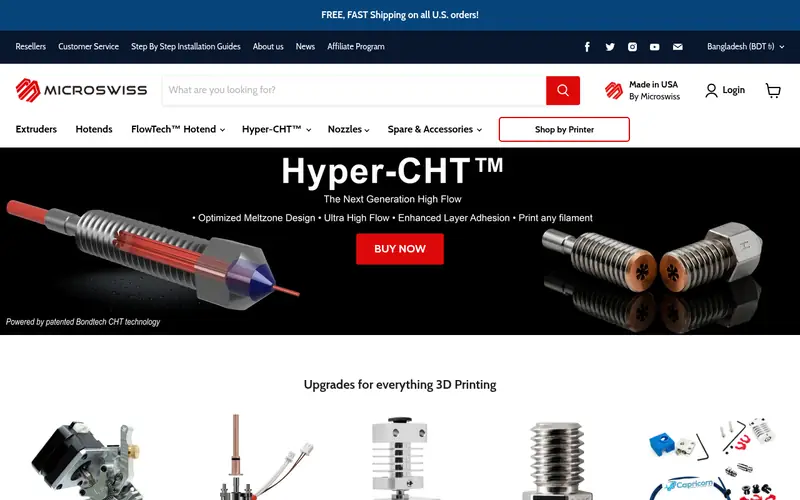
Micro Swiss makes the CM2 in a hardened steel construction aimed at abrasive materials, in thread patterns that fit MK8 and many Creality-style hotends. It is a practical wear upgrade for owners of stock-style hotends who print filled filament but do not want to change the whole hotend.
Hardened steel conducts heat less well than brass, so some users run a little hotter. Check the exact thread and length for your printer before ordering, since Micro Swiss lists multiple fitments.
Where the price comes from
Check current retail price. Hardware prices move often, so check the Micro Swiss CM2 Nozzle maker page or a retailer before you buy.
Benefits
- Hardened steel tip for abrasive filament
- fits common MK8 and Creality-style hotends
- available in several bore sizes
Drawbacks
- Steel needs slightly higher temperatures
- price varies by size and retailer
Use case to skip: this limit matters to you: steel needs slightly higher temperatures.
Our take. A sensible pick for wear resistance on MK8 and CR-style hotends.
If it does not fit, compare E3D Revo Nozzle or E3D Revo ObXidian in this list.
- Best for
- Mosquito and Copperhead hotend owners
- Standout
- Vanadium tool steel for wear resistance
- Starting price
- Check current retail price
- Free plan or trial
- One-time hardware purchase
Slice Engineering's Vanadium nozzle is a tool-steel nozzle made for its Mosquito and Copperhead hotends. The material is chosen for wear resistance on abrasive filament while keeping the hotend's compact form factor. It suits owners already inside the Slice ecosystem.
The main limit is fitment: this is not a general-purpose MK8 part. Buyers on other hotends should look at Slice's other nozzle lines or a different brand entirely.
Where the price comes from
Check current retail price. Hardware prices move often, so check the Slice Engineering Vanadium Nozzle maker page or a retailer before you buy.
Benefits
- Vanadium tool steel for wear resistance
- designed for Slice hotend patterns
- available in multiple bore sizes
Drawbacks
- Fits Slice hotends primarily
- premium price
Use case to skip: this limit matters to you: fits Slice hotends primarily.
Our take. A sensible pick for mosquito and Copperhead hotend owners.
If it does not fit, compare E3D Revo Nozzle or E3D Revo ObXidian in this list.
- Best for
- Budget high-flow builds
- Standout
- Lower-cost take on the channeled high-flow design
- Starting price
- Check current retail price
- Free plan or trial
- One-time hardware purchase
Trianglelab sells a CHT-style nozzle with the same split-channel idea as the Bondtech original, at a lower price point. It is a common choice for budget builds and for testing whether high flow helps before spending more. Thread patterns cover V6 and MK8-style hotends.
The trade-off is consistency. Reports on community forums mention batch variation, so inspect the bore and thread when the part arrives and return anything that looks rough.
Where the price comes from
Check current retail price. Hardware prices move often, so check the Trianglelab CHT Nozzle maker page or a retailer before you buy.
Benefits
- Lower-cost take on the channeled high-flow design
- several thread patterns offered
- useful for testing flow gains cheaply
Drawbacks
- Quality control varies by batch
- check thread fit on arrival
Use case to skip: this limit matters to you: quality control varies by batch.
Our take. A sensible pick for budget high-flow builds.
If it does not fit, compare E3D Revo Nozzle or E3D Revo ObXidian in this list.
- Best for
- Abrasive filament on standard hotends
- Standout
- Ruby tip resists abrasive wear
- Starting price
- Check current retail price
- Free plan or trial
- One-time hardware purchase
The Olsson Ruby uses a small ruby insert at the tip to resist abrasion from filled filaments. It has been a standard wear-resistant option for years and is sold in V6 and MK8 patterns. It suits users who print a lot of carbon-fibre or metal-filled material on a standard hotend.
The ruby is hard but brittle. A crash into the bed or a blob can crack it, and at this price that hurts. Handle it carefully and keep your Z offset sane.
Where the price comes from
Check current retail price. Hardware prices move often, so check the Olsson Ruby Nozzle maker page or a retailer before you buy.
Benefits
- Ruby tip resists abrasive wear
- long-established design
- fits common V6 and MK8 patterns
Drawbacks
- Brittle tip can crack on crashes
- high price per nozzle
Use case to skip: this limit matters to you: brittle tip can crack on crashes.
Our take. A sensible pick for abrasive filament on standard hotends.
If it does not fit, compare E3D Revo Nozzle or E3D Revo ObXidian in this list.
What specs matter when you buy
Bore size is the first decision. A 0.4 mm nozzle is the general default for detail and reasonable speed. A 0.6 mm nozzle prints wider lines and moves more plastic per second, which suits functional parts. A 0.8 mm nozzle is for fast, chunky prints where surface detail matters less. Match the bore to the job, not to a spec sheet number.
Material decides wear life. Brass is cheap and conducts heat well but erodes fast on carbon-fibre, glass-filled and glow filaments. Hardened steel and tool steel last far longer on those materials but conduct heat less well, so you may need slightly higher temperatures. Ruby-tipped nozzles resist abrasion but can crack on impact.
Fitment is the trap. Thread pattern and overall length differ between V6, MK8, Revo and Slice hotends, and a nozzle that does not seat correctly will leak. Check the hotend maker's own compatibility list before ordering. High-flow designs such as channeled nozzles also change flow behaviour, so plan to retune slicer flow and pressure advance after fitting.
Questions worth answering first
Buying checklist
- Confirm your hotend family (Revo, V6, MK8, Mosquito) and match the nozzle thread and length to it.
- Decide whether you print abrasive filament; if so, choose hardened steel or ruby over brass.
- Pick a bore size for your typical work: 0.4 mm for detail, 0.6 mm or 0.8 mm for speed.
- Check whether the nozzle is a cold-swap design or needs hot tightening and a torque spec.
- Budget for retuning flow and pressure advance if you move to a high-flow design.
- Verify the current price and return policy on the vendor's own site before paying.
FAQ
Do I need a hardened nozzle for carbon-fibre filament?
Yes. Brass erodes quickly on carbon-fibre and glass-filled material, which changes the bore over time. Hardened steel, tool steel or a ruby tip lasts much longer. If you print these materials regularly, the extra cost is usually worth it.
Can I use a 0.6 mm nozzle instead of 0.4 mm?
Yes, and many users do. A 0.6 mm nozzle prints faster and stronger parts but shows less fine detail. You will need to adjust slicer settings, including line width and flow, after the swap.
What is a high-flow nozzle?
A high-flow nozzle changes the internal melt geometry, often by splitting the filament into thinner strands, so it melts faster. That raises achievable volumetric flow on the same hotend. Bondtech's CHT is the best-known example.
Are Revo nozzles compatible with V6 hotends?
No. Revo nozzles use their own integrated heater and thermistor design and fit only Revo hotends. A V6 hotend needs a V6-pattern nozzle instead.
Why does my new nozzle leak at the heater block?
Usually because it was not seated correctly. Some nozzles need hot tightening to a specified torque, and a gap at the heat break lets plastic escape. Follow the hotend maker's installation instructions exactly.
How often should I replace a nozzle?
There is no fixed interval. Replace it when print quality drops, the bore looks worn or oval, or the tip is damaged. Abrasive filament shortens life considerably compared with plain PLA.
Sources we checked
Change log: First published 22 Nov 2026.